Cocos to Rodrigues, Completed

Day 11 – Windy/bumpy all day. 195 miles noon to noon. Frustrating not to hit 200, though we probably would if I chose a slightly different 24 hour period. Our speed always seems to be over 9 knots, but of course with the waves we’re never sailing in a straight line.

We lost our hydrogenerator today. That is, the blades once again broke off the propeller. The $400 propeller…

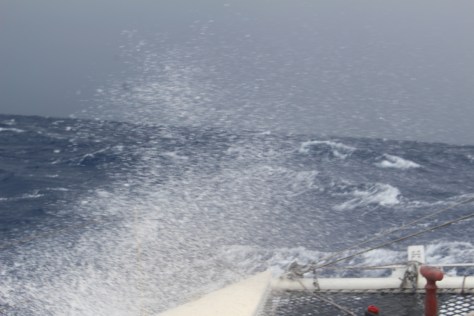
It was a pretty day…sunny…but we stayed inside due to the occasional spray dowsing the cockpit/deck. For the night we have triple reefed the main, and reefed the jib a little as well. Tomorrow they say it is going to blow even harder. Hopefully it will be more from the east (behind us), not from the south (hitting us broadside). If the latter it will be a wild and crazy ride! 350 miles to go.

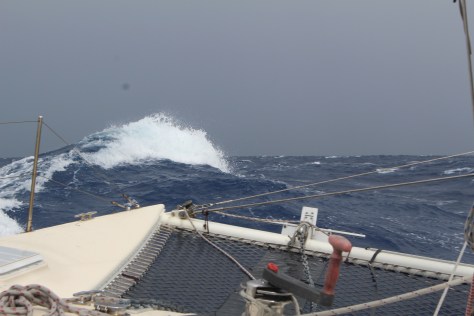
Day 12 – The wind stayed mostly south, and it’s been a wild and crazy ride. Almost impossible to sleep last night, until you were so worn out you just didn’t care what was happening around you; then you might pass out for an hour. It’s not easy for me to describe, and probably hard for you to imagine. For starters there is the whoosh of water rushing by your ear at 10+ knots, while your berth is moving around like a carnival ride. That’s the relatively pleasant part. The water is very lumpy, of course, and some of those lumps get between the catamaran’s hulls and slam into the bridge deck — the structure that connects the hulls, that comprises the floor of the pilothouse, and the underside of my berth. Some lumps hit with a dull thud. Others hit like a wrecking ball, with a deafening crash and an impact that wracks the entire boat. It feels like the boat, and the crew, are being shaken apart.

Then there is the weird wail emanating from the wind generator. It has an internal brake that kicks in at about 35 knots, so the blades don’t spin themselves into oblivion. The brake has the vibrato electronic hum of a Jedi warrior’s light saber in combat, but with an intensity more like the air horn of a large truck closing fast and wanting to pass. Go ahead — picture each of those, and then add them together. Lying in bed, this wail tells you that the wind is still howling outside at 35+ knots.

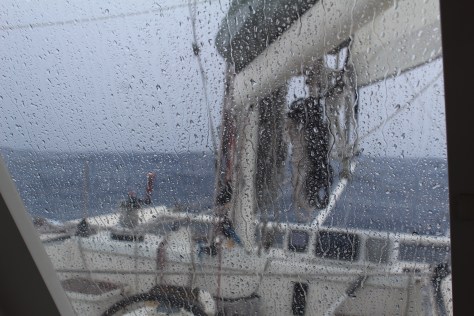
Then there are the waves that break against the side of the hull, since we are sailing crosswise to the wind/waves. This brings another kind of crash, and it lifts the boat up sideways as though it might flip it over, and sheets of salt spray fly at the pilothouse windows. All the hatches are closed except for one on the sheltered/downwind side. One wave sent such solid water over the top of the pilothouse that it splashed in that open hatch.

This all occurs in the dark, of course. You can’t see the waves coming. The hardest thing on one’s stomach is the anticipation — when you hear one about to hit, and feel the boat begin to lift, you brace yourself for what may or may not come next. The ones under the bridge deck come with no warning — just a sudden impact from below. It would be foolhardy to try to stand without at least one hand firmly on a handhold.

One wave lifted our man-overboard horseshoe buoy out of its bracket on the lifelines. It caught on a line on deck, so it didn’t go overboard, and it’s strobe light began to flash. A bonus feature of the carnival ride: visual chaos. It was almost funny going out to retrieve it — trying to do it quickly before a wave drenched me, yet being blinded by the flash of the strobe.

Add to the general pandemonium the items flying about the cabin. Books flying off of shelves where they had been securely (apparently not) wedged in place. My plastic glass of water flying off the table to the floor. Locker doors unlatching and banging open and shut. Our hard plastic granola container crashing to the floor and spilling its contents. Silverware rattling. Dishes (and a Thermos, a coffee maker, and miscellaneous other items) banging about in the sink, where they had been put to keep them from flying elsewhere. Plus the surprisingly loud sucking/gurgling sound made by the sink drain as waves rush by its exit. The bilge pump alarm suddenly trumping all other noises for twenty seconds, while some of the seawater that finds its way into our engine rooms gets returned to the sea.

Underlying it all is the constant gnawing fear of whether the boat and rig can withstand the unending pounding. Can the crew…?

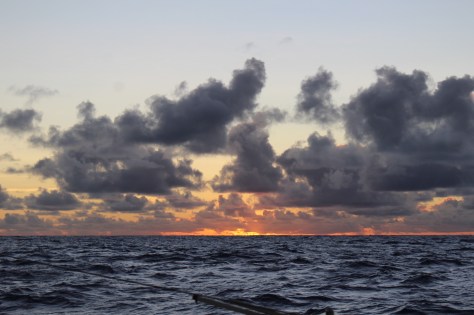
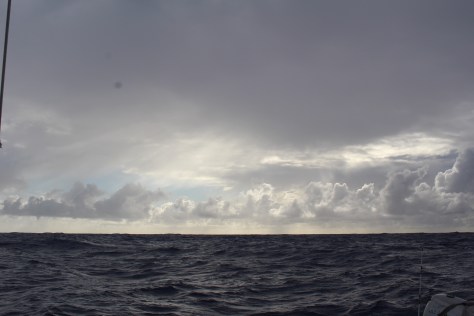
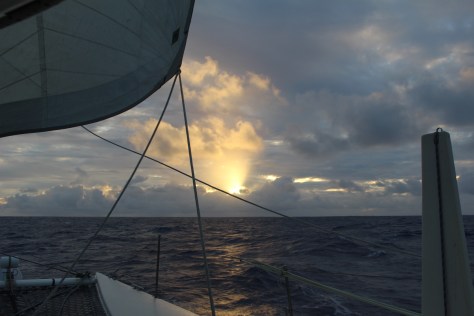
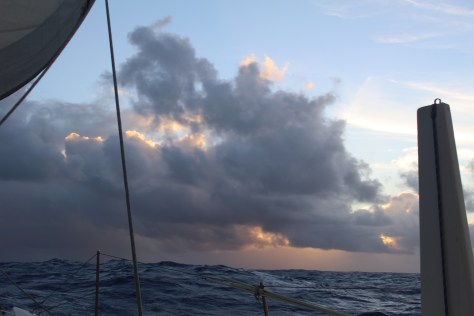
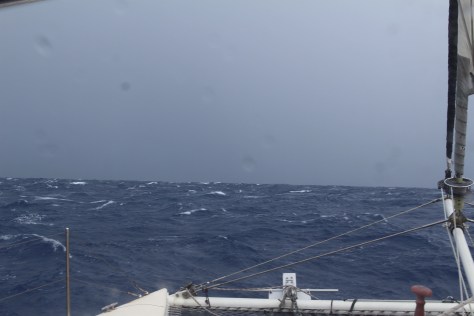
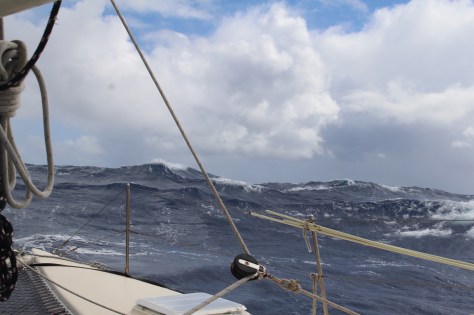
At dawn the tension eases somewhat. The waves don’t look as awful as they are imagined in the dark. The wind eases back to 30 knots, instead of 35. It’s a sunny day, and that lifts ones spirits even on a day when the priorities are to get some food down and get some sleep. Ideally we would bear off and run with the waves, and it would be much easier, probably even fun. But that is not an option, as we would miss Rodrigues. We have to hold our crosswise course. The wind is ever so slightly aft, which I am very thankful for. Just a little more forward and the crashing and banging would increase dramatically. It is tempting to bear off just a little. But what if the wind goes even higher (in strength or direction)? We would have to make up that lost distance to windward, and it could be more difficult then than what we are experiencing now. So our course is just a couple degrees to windward of our destination, those few degrees providing a very slim margin of error/safety. 250 miles to go. If we can keep our speed up (without breaking anything important) we can have just one more night of this, and arrive in daylight tomorrow.

@@@@@@

Later in the day the wind gusted up to 40 knots. And while we were talking about lowering the mainsail altogether (it was already triple reefed), a wave picked up the back of the boat and sent us surfing at 22 knots! That is a record for No Regrets, and it is a record that I have no desire to break! Needless to say, we dropped the mainsail, and we have been sailing with just a reefed jib since. At nightfall it seems to be calming down (again), though the prediction is for continued high winds through the night.

Noon to noon run was 206 nautical miles. We even got an email from Jimmy Cornell congratulating us on an impressive run!

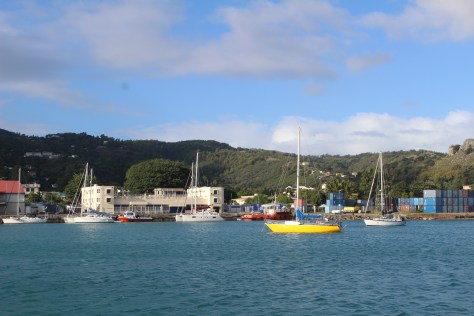
Day 13 – By noon we were entering Port Mathurin harbor on Rodrigues. Twelve days and a few hours to cover 2,000 miles. We just managed to clear in before everyone shuts down at 4pm. And we had a beer and dinner with Chris from Tom Tom, who safely made it in yesterday. I’m very much looking forward to some real sleep!

Our passage was fast. But it has been the most unpleasant passage I have ever made. Glad to have it behind me. We lost one spinnaker; broke the sock used to raise and lower another; lost the blades off our hydrogenerator; had our wind generator shake loose from its brackets (but it is already back together and functioning); the throttle control for one engine is not working, the temperature sensor failed but came back on the other. And we lost three fishing lures while catching no fish. Par for this course, perhaps…?
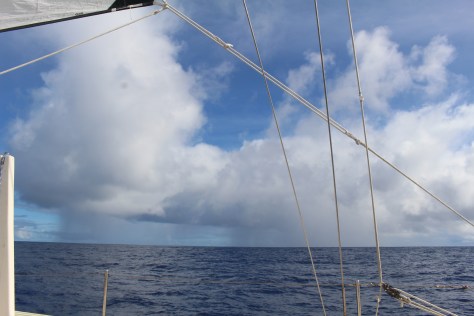
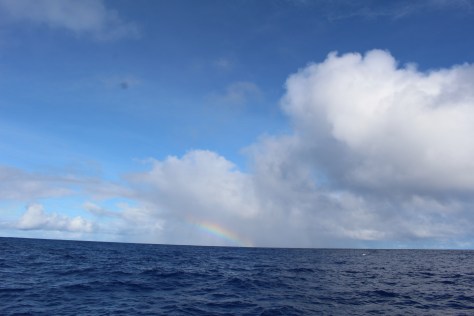
image

image

image

image

image

image

imageimage

image

imageimageimage

image

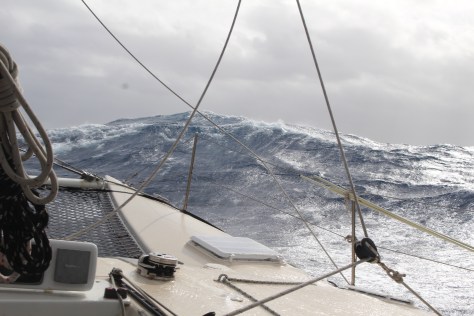
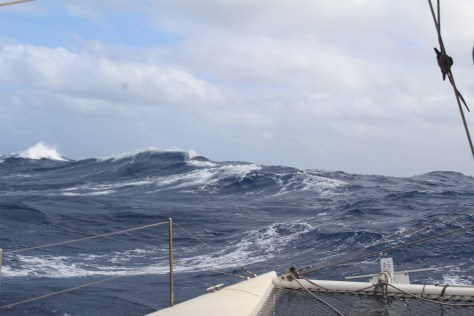
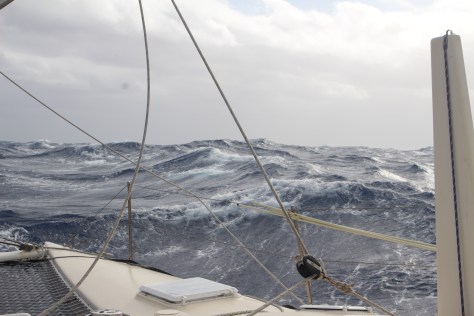
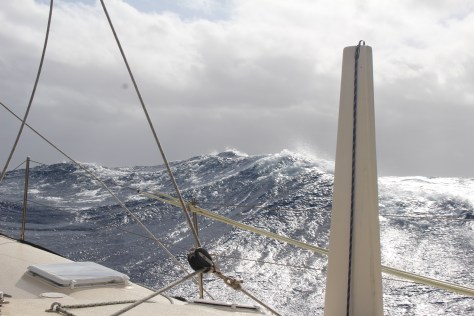
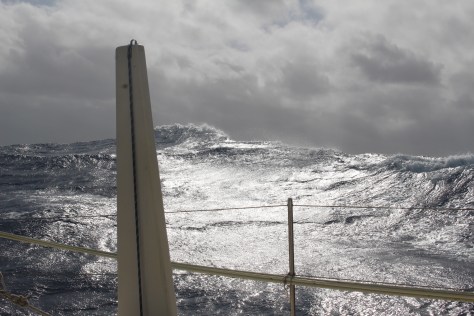
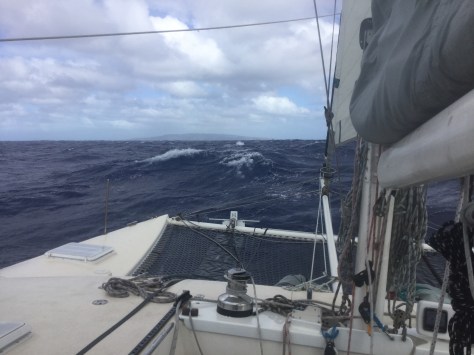
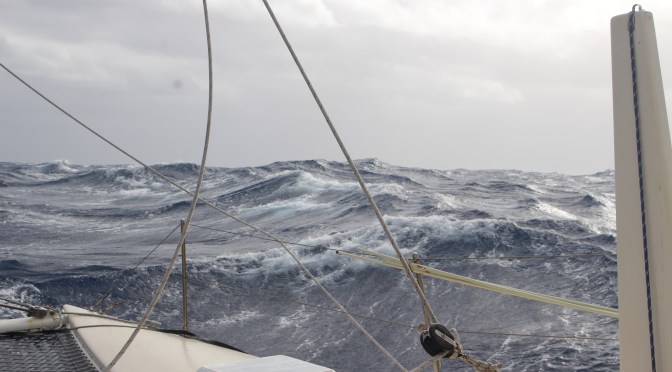
Photos of waves never capture their majesty, their vastness, their power, or even their height. But these should give you an idea…
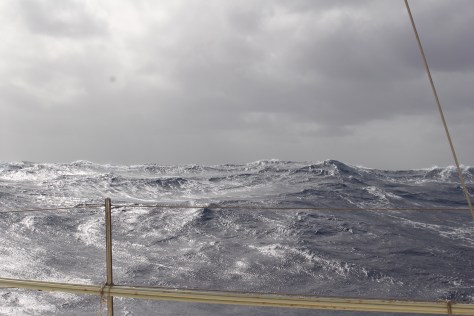
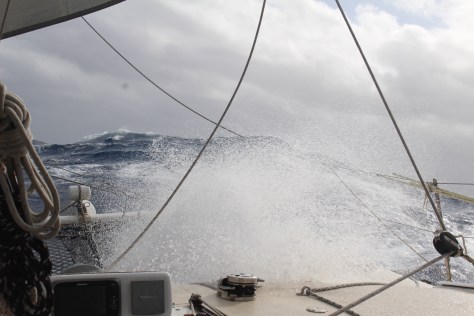
imageimageimage

image

image
Looking astern at the mountain of water approaching can be particularly daunting.

.

imageimage


imageimage


image
Rodrigues in sight


image
Port Mathurin, Rodrigues


Cocos to Rodriguez, Part 2

Day 5 – Beautiful sailing all day. A respectable 160 miles noon to noon.

On Verra was already west of Tom Tom, and 35 miles away, so they did not connect by VHF radio. But Tom Tom was on the radio net tonight. His wind has decreased to 20 knots, and he is continuing to sail slowly on. He sounded the same as always — upbeat! It was nice to chat with him a little, and pretty clear that he appreciated the contact.

This is a particularly empty ocean. For five days I have not seen a boat or a light or an airplane. Just water and waves, sky and clouds, and occasionally birds and fish.

Day 6 – Today was a frustrating sailing day, with not quite enough wind. But worse, the wind was constantly shifting to the east (begging for the spinnaker) and then the south (requiring that the spinnaker come down). But at sunset the breeze freshened and came south, and has stayed there. We are happily sailing with mainsail and screecher at nearly 8 knots. Hope these conditions hold for my watch in 4 hours! Our 24 hour run was 150 nautical miles.

The update from Tom Tom tonight is that he is doing okay, but he has winds 25 – 30 knots. All the other boats on the net report 20 knots or less. Chris is taking quite a pounding!

Day 7 – A mix of great sailing and (now) flailing in the waves with wind too far astern to steady the sails, making for uncomfortable and noisy going. 160 miles run.

Day 8 – 162 miles run. Completed first week of the passage, and crossed the half way point. Baked bread to celebrate.

Weather deteriorated during the day, with heavy rain at times, and wind gusting to 30 knots. Twice we went out to reef, and both times as soon as we were outside both the wind and rain seemed to increase. Oh well. Glad to have two reefs in for the night, not so much that we need it right now, but probably we will at some point before morning. A problem now is the jib collapsing and filling, with a crash that is preventing Tim from getting to sleep. There was also a period earlier when we lost our wind instrument data (which would make the night sailing in the gyrating seas very difficult). But a reboot of the electronics brought it back. Dolphins visited today. Lost a (another) fishing lure.

Very wet on board now, especially in the pilothouse, but also working its way toward our sleeping quarters. Boats ahead also report rough conditions and overcast, but at least not pouring rain. Hopefully we get a chance to dry out soon.

Day 9 – Frustrating day. Started out dry, but got wet. Wind up and down, backing and veering, so we always seemed to have the wrong sail combination set. Our track looks like we were drunk, wobbling north and south in the wind shifts. We flew our small spinnaker for a while. Then the wind decreased to about 14 knots and stayed there for a couple hours, leaving us underpowered. So we put up the big spinnaker (old Parasailor). Within minutes the wind was blowing over 20 knots, and we were screaming down waves, sometimes hitting 15 knots (while I tried to prepare lunch!). We talked about getting the sail down, but thought we would wait for a break in the rain…and then the wind eased to maybe we would keep it up…and then despite the lighter wind it suddenly blew out — major tears all along the foot and up one leech! This is the third time we have torn this sail, and I doubt we will bother repairing it yet again.

A ship passed us only a mile away, but we couldn’t see it in the rain. Eerie.

For the night we are trying a single reefed main and slightly reefed jib, the latter to try to keep it from collapsing and banging around when the wind shifts aft. Pretty nice going at the moment, though very bumpy. This ocean is not a comfortable one!

Day 10 – When I came on watch last night, TC and I put in a second reef. When Tim came on watch four hours later, he and I put in a third. Very rough; difficult to sleep in the crashing and banging. But today was a pretty day. The wind was far around to the south, so we are broadside to the waves. Spray in the cockpit means we’ve been inside the pilothouse all day. And it looks like we will be inside for the remainder of the crossing, as the wind predictions have it increasing in the days ahead. 550 miles to go. 185 noon-to-noon run. If we can keep our speed up (without breaking anything important) we can get to Rodrigues in three days. But the increasing wind is a wild card. If it kicks up a violent sea we may have to slow down. TBD…

Cocos to Rodriguez, Part 1

Final prep… Went aloft to check rigging, and tightened a creaking nut/bolt that attaches the lower shrouds to the mast. Tightened the one for the running back stays, too. Noticed that the sheave at the masthead for the main halyard moves around a lot, probably worn where the pin goes through it. Don’t think this is an immediate issue, but something to add to the list for repair.

Dove to do a last scraping of barnacles, and noticed that we have a chunk missing from the bottom of one daggerboard. Not sure how/where/when that happened. Another item for future repair. Bought our expensive diesel. Filled a propane tank (also expensive). Got our fresh produce (not really fresh, since it is flown in from Australia; also expensive). Watched a movie with dinner the night before. Got our last Internet licks.

Day 1 – A twinge of sadness about leaving beautiful Cocos, and a little reluctance to leave the smooth anchorage for the open Indian Ocean…but…underway at 8am. Instead of Goodbye, they tend to say, “See you next time around!” We are setting our course due west, which is north of the direct path, because the wind predictions show a calm area ahead to the south. That area is expected to fill in after a few days; then we can adjust course to the south.

It was only one hour underway when our first casualty occurred. Our computer died. The most important function of the computer, at least at sea, is to control the modem that allows us to send email via the radio. Luckily, Tim had his spare laptop, and had loaded it with the software. So we can still communicate (and send this text to Hallie to post to the blog).

It has been a good first day. Winds mostly about 16 knots on our quarter. Relatively small seas; relatively small swell coming up from the Southern Ocean. It’s great to have a peaceful day for adjustment to the motion of the sea.

Day 2 – Near perfect sailing. Wind about 14 knots on the quarter. Flew our spinnaker most of the day, thought we brought it down for the night. We are very, very lucky to have these mild conditions up front. Lots of birds; lots of flying fish.

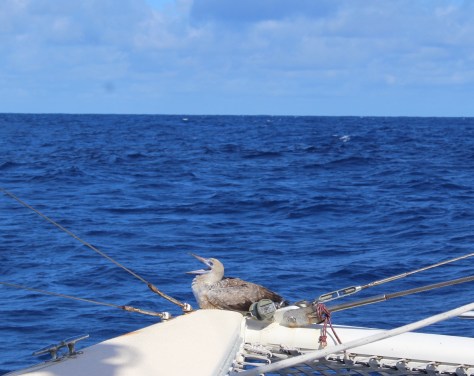
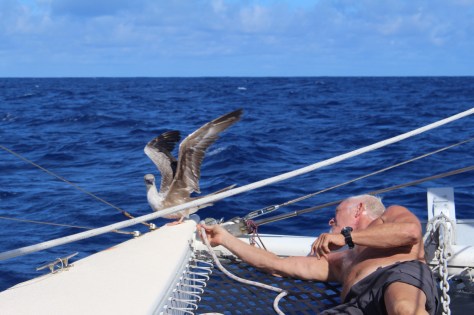
Day 3 – We had a bird (shearwater?) land on our bow last evening, and during the night she moved back toward the cockpit, about six feet from where we sit. She preened for hours, then tucker her head under a wing and snoozed. In the morning she flew off for ten minutes, then landed on the bow again. Until we put up the spinnaker, and had to run a line near her — then she left.

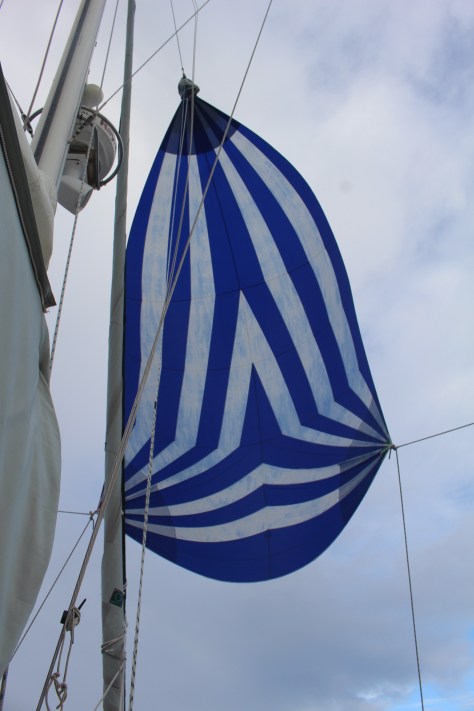
We had some major spinnaker excitement. We were setting our asymmetrical, and the sock was difficult to raise. We had all our attention on the situation aloft, and didn’t notice the wind starting to fill the sail with a wrap in it. We couldn’t get the wrap out; the sheets were twisted together so we couldn’t ease either; we couldn’t get the sock down; so we had a mess. We lowered the halyard and managed to pull the sail aboard before it dragged into the sea. The hoop at the bottom of the sock was broken. Don’t know for sure if that was a cause or an effect of our struggles.

So we stowed that spinnaker and broke out the old Parasailor (which is no longer a Parasailor since we repaired its latest tear by removing the wing and filling in the slot with solid fabric). This time the sock control lines got twisted/jammed/fouled. The spinnaker was flying okay, but the sock was not right, and one of the control lines was yanked from my hands and swinging up out of reach. We managed to grab it with the boat hook, and pull the sail down, half socked. Then we raised it in its sock again, and sorted everything out as it went up. The sail worked beautifully — if anything being more stable and more effective than it was when it had the Parasailor wing!

It’s been another beautiful sailing day, and we were tempted to leave the spinnaker up tonight. But after the reminders of how things can go wrong with spinnakers, we decided to switch to the screecher. This change reduces our speed by a knot or slightly more, but we are keeping apace with Maggie (we are about 15 miles ahead of them), so no need for speed.

Day 4 – Beautiful day, but not enough wind. Our noon-to-noon distance runs so far have been pretty feeble: 138, 142 and 132 (nautical miles between actual noon positions). But late this afternoon we got a nice breeze from the south, and the sailing is good for now.

We received an email around mid-day from Chris, the singlehander aboard Tom Tom. He reported that his forestay had parted, and although his mast was still standing he was in rough seas and had concerns about it. He had rigged several lines to provide support to the mast, but everything was tenuous in the rough conditions. We let him know we are headed in his direction, but we are 575 miles behind him. He appreciated our being “there” even if “there” is four days away. This evening I got on our SSB radio net (a loose association of boats crossing the Indian Ocean and checking in on the radio daily), and spoke with Alicia aboard On Verra. They are only 25 miles from Tom Tom. But they don’t have email at sea. So they offered to alter course toward Chris, and try him on the VHF radio as they get closer. Chris is still sailing, with greatly reduced sail, and he is not asking for assistance at this time. Hopefully he will be able to sail slowly into Rodrigues, but we will try to “have his back.”