
Tag Archives: blue planet odyssey

Panama

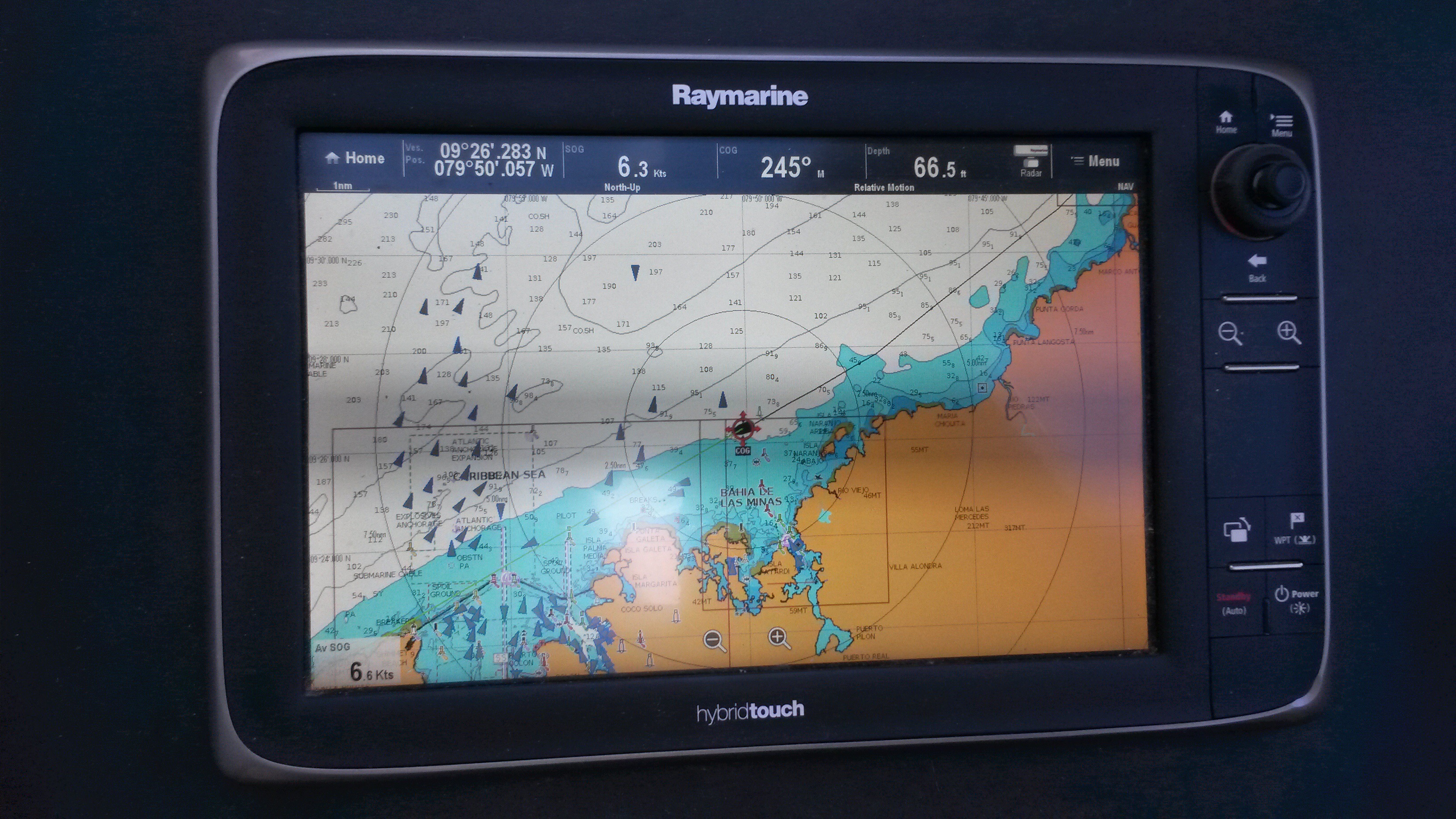
The excitement about the Panama Canal builds as we approach Colon and see many ships in the distance. In fact, check out this photo taken of our chart plotter. Each little triangle is a ship. They are almost all anchored, waiting to transit the canal (or in some cases to be loaded/unloaded in the port). Can be tricky to pick out the one that’s actually moving, that needs to be avoided!
image

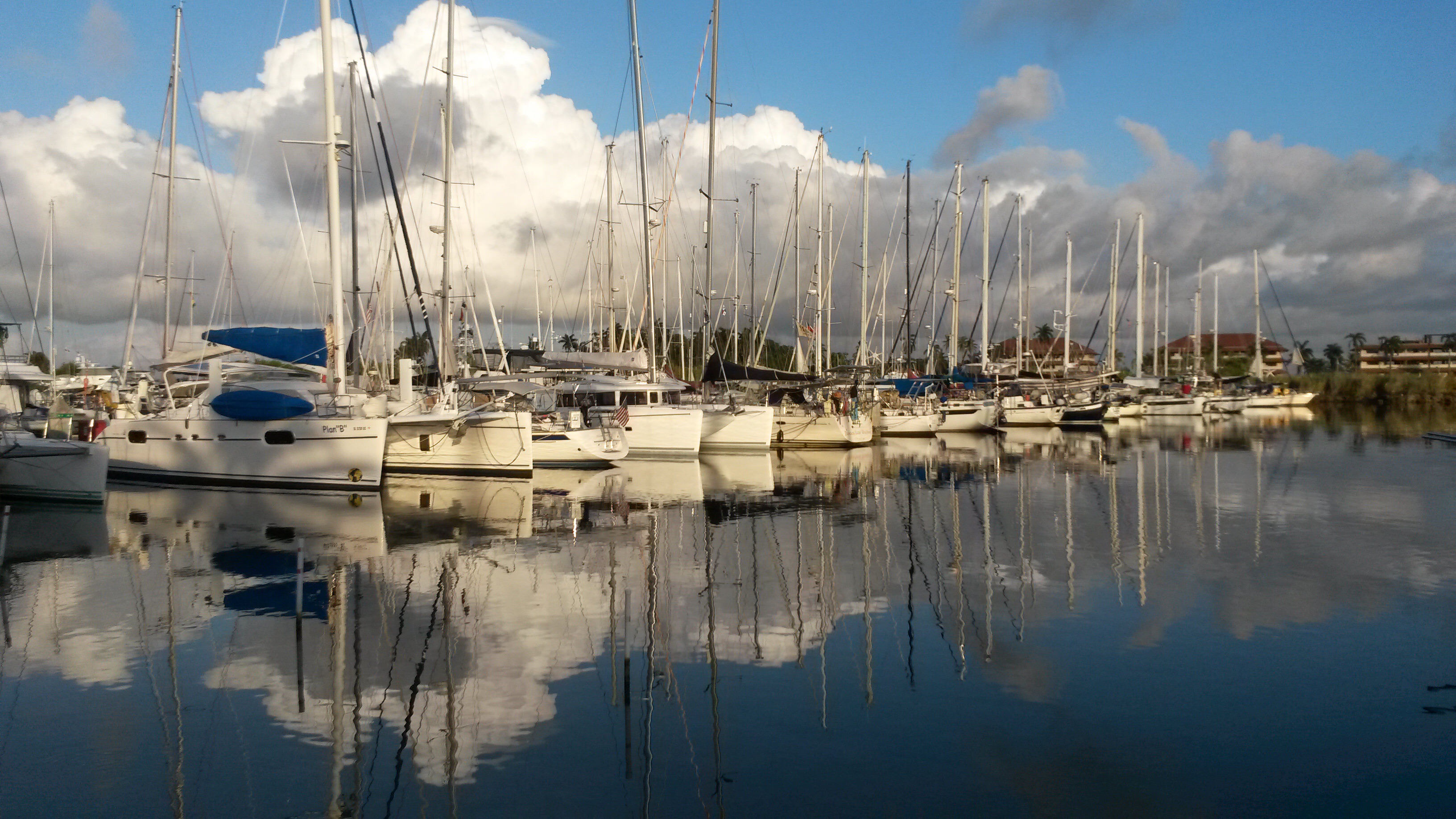
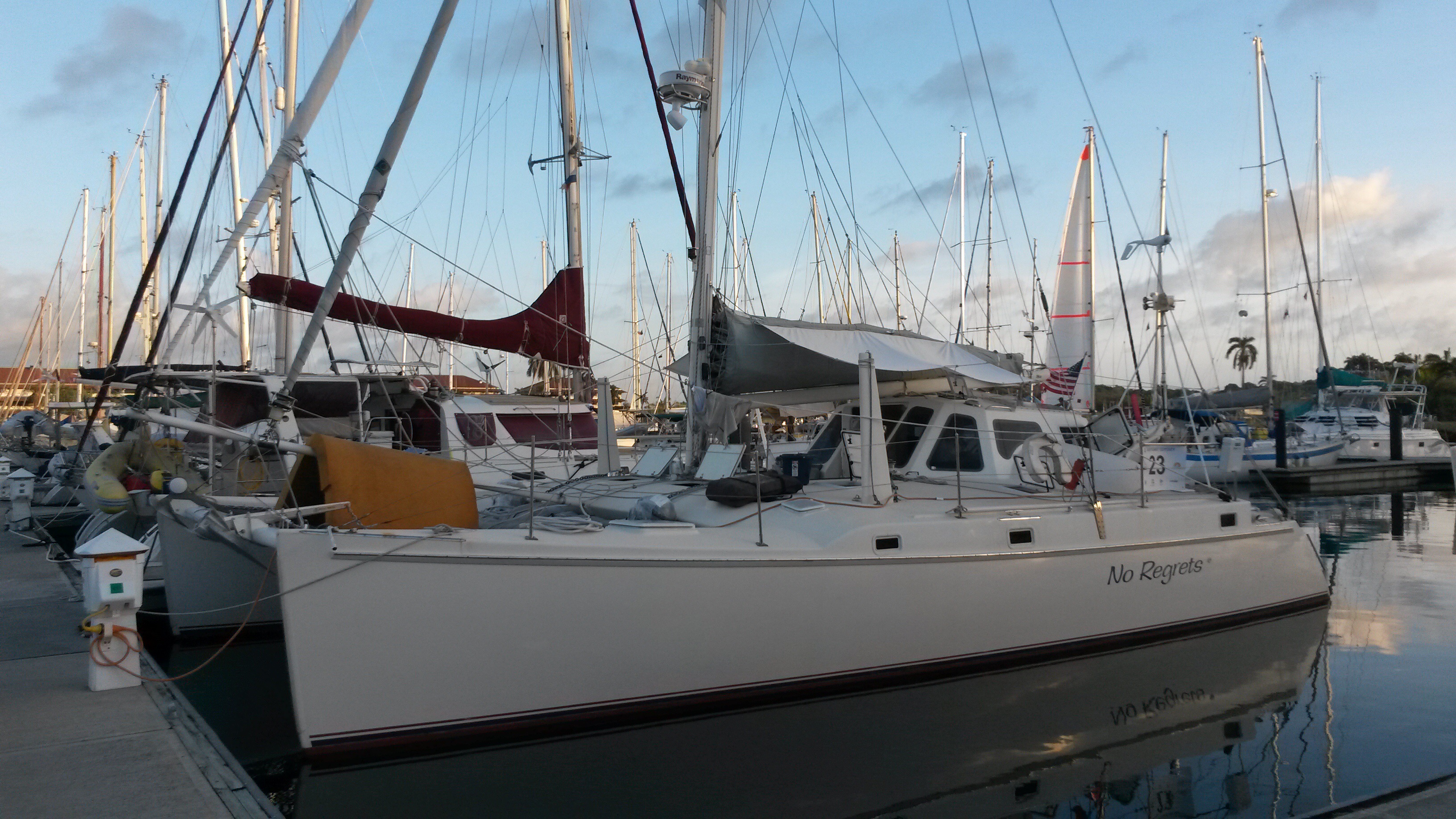
Crossing the swath of ships, we get to Shelter Bay Marina. Ah, showers and laundry services and a restaurant!
image

image

Our new alternator was successfully (and expensively!) delivered. We installed it, and it works fine. A new propeller for our hydro-generator has also arrived, and is now installed. We discovered two broken bits of rigging hardware, and people have promised to help us with replacements, but they haven’t shown up yet. We have also noticed that the bolts holding the stays for our sprit (where the forward sail is connected) are starting to bend. The connection for these stays is not very well designed, and we are hoping to come up with a better solution before we head into the Pacific. In other words, we have boat projects still.

But also we have BPO things to do. For starters, this is the first place where the Key West boats and the boats that started in Martinique are together at a marina. So there is lots of socializing, both on boats and at the restaurant, as we all get to know each other. For some reason our crew seems to have an affinity for the Martinique crowd more than the Key West contingent. (Not that there’s anyone we don’t like, of course. And probably by the time we go through the Galapagos we will no longer be making a distinction about where boats started.) And Jimmy Cornell (BPO organizer) is in town, and planning some of our activities.

We had a delightful briefing by Jimmy about the wonders to come of the Galapagos, the Marquesas, the Tuomotus, the Society Islands (which include Tahiti), and even a little hint about what he’s cooking up for Indonesia. We’ve also had a less pleasant briefing about the administrative requirements for entering the Galapagos, which are onerous and at times non-sensical, and which seem to change almost daily. Boats have been turned away for not complying with unreasonable requirements!

But first comes the Canal. Transit through the Canal also has many requirements. Each boat requires, in addition to the “master” of the ship, four line handlers. We will have to hire two. And we must have four 125′ long 7/8″ lines. We have zero that qualify, but the BPO is providing these, plus tires to be available as fenders. A measurer has to come in advance, and ask lots of questions about the boat, measure its length and width, and provide an official number to identify it for Canal purposes. We’ve made it through this step. All the BPO boats had to be measured before the Canal Authority would schedule our transit. On Tuesday the Authority gave us permission to transit on Wednesday. Wait!! No one was ready; provisioning is not done; projects are in mid-stream. Jimmy had been pushing for fast transit because it can take many days before it is scheduled, but now he had to reply that we couldn’t go on the schedule offered!

The revised plan is for 6 boats to start Saturday and complete Sunday, and the remaining 5 to start Monday and complete Tuesday. With the revised schedule they could not give us an entire lock to our fleet of 11 boats, because every boat requires a Canal pilot (who gives directions where to go, how fast, how to tie up in the locks, etc), and this weekend being Carnival weekend they say they had to cancel some scheduled vacations to accommodate us at all! We are in the second group, which reduces the time pressure on us and our incomplete projects. Our two extra days won’t help much, though, since they are Saturday and Sunday, when we won’t be able to get any materials or outside assistance. The time will help me catch up with my blog though, before we head to the big no-wifi zone of the ocean…

With this post, I am going to consider Part 1 of the Blue Planet Odyssey complete. The BPO isn’t really divided into “parts” — this is my own view of it. Getting to the Canal staging area was, in my mind, the first part. Part 2 will take us through the Canal and include many adventures in the Pacific Ocean.

Cruising in San Blas

Thursday: We headed east to the more classic sandy cay anchorages behind the reefs. But first came engine issues. The starboard alternator is putting out low amps, like 10 instead of 80. We spent some time investigating this, but to no avail. Then the starboard engine failed to generate much thrust, when we needed it to clear another boat, in the process of raising the anchor. For some long seconds we were seriously thinking we might have another collision, or end up on the reef to leeward. (We’ve seen four boats on reefs since we arrived, and we’re told they are all recent…) And then the engine started running okay. Bad injector…? It remains a mystery, as does the alternator output.

These travails are nearly forgotten, as we are now anchored in a fabulously beautiful spot, the sound of distant surf on the reefs as a backdrop. A sandy palm-covered cay a short distance away; an unimpeded wind keeping things cool. We all had the feeling today that we have finally ‘arrived.’ Bread is baking; chicken is thawing; sprouts are ready to eat. As we have traditionally said on my boats, “This hardly sucks at all!”

Friday: Some work on the wind generator (successful), some snorkeling, some troubleshooting of the alternator (unsuccessful), and a lively social gathering aboard Chapter Two (big catamaran; easily accommodated all of us) of the four crews that left from Key West.

Saturday: A lively social gathering on BBQ Cay of (almost) all the BPO and Pacific Odyssey crews. So many names to learn, and who is on which boat!

As a small flotilla of dinghies pulled up on the beach of the tiny island we were greeted by a welcoming committee of two locals who demanded $3 per person to visit the island. This was unexpected; no one had money with them. Some thought it was fair, like a park fee (the island was nicely groomed). Others thought it was crazy and we should go elsewhere. Others thought it was reasonable, but questioned who the two were, and what right they had to ask for money. I went back to the boat (ours was one of the closest), and got money to pay for everyone, and suddenly everyone was “amigos” and we had a good time.

Sunday: We had plans to move on to cays to the east, but instead the entire day was spent learning about alternators and voltage regulators. Not an unpleasant day though. Wondering how the Patriots did in the Superbowl…

Monday: Sailed 10 miles southeast to another section of the San Blas islands. Took the dinghy up the Rio Diablo, which provided jungle-like scenery. Several dugout canoes on the river, paddling upstream to get water to bring back to the Guna island just offshore. We towed a very friendly young guy a mile or so up the river, and on our way back we towed two canoes a mile or so downstream. Another paddler laughed about how the others must be too tired to paddle. Everyone seemed to be very friendly. There were lots of birds, and it was nice to hear their calls in the tall trees. The island here is much more developed than the others we’ve been to. We bought some provisions at a store and we went to dinner at a ‘restaurant’ (where we were the only customers).

I know y’all want photos. We expect to be in Colon within a week, and hopefully a good wifi connection there will bring photos shortly thereafter.

Life in San Blas

We were thinking of moving to one of the nice reef areas, about 15 miles east. But first Tim suggested that we visit the island/town behind us. I hesitated, wondering if “outsiders” would be welcome there. But one of the great things about traveling with Tim is his uninhibited interaction with everyone. I get to tag along and see where it leads.

The town consists mostly of houses with thatched roofs, plus some with metal roofs with water catchment systems. (There is no fresh water on the island — only rainwater or water brought from the mainland.) I had assumed that it was houses only, but there was a sign near where we landed the dinghy indicating crafts for sale. Then as we ventured further, along paths winding between closely-spaced houses, there were more signs…for stores, for the church, for the school, for a meeting house, for the medical clinic.

Enter Nestor, who speaks reasonably good English (slightly better than our Spanish), who introduces himself and adopts us. He answers dozens of questions; he has a cold beer with us (at our expense, of course); he guides us to the bakery, where the bread will be ready in 15 minutes. Ten minutes later, when it still will be ready in 15 minutes, he suggests we go to HIS island, Nalunega, just across a short stretch of water. We go, we visit the store there, we buy hot empanadas, we say no to many, many molas, we see the school (closed for vacation until March), and then he asks if we would like him to prepare a dinner for us I his house that evening Yes!

We go back to the first island, Wichubwala, to pick up our bread. Nestor takes his dugout canoe, and Tim rides with him. Bread in hand, we go a few yards to another island (or is it just some structures built over the water?) to buy lobsters for the meal Nestor will make. And finally we get back to the boat. This has been a much bigger outing than I had anticipated, and I’m hot and tired and thirsty. But what a great opportunity to learn how the Guna people live!

When we return in the evening to Nalunega, there is much more activity than earlier in the heat of the day. Lots of kids running around, lots more people on the paths among the houses. And a basketball game, complete with referee! I was going to ask if people played soccer, but I realized there was no space on the island for it. Nestor reports 700 people live on the island, which is a most a 3 minute walk from end to end.

Solar panels sprout between the thatched roofs. They attach to batteries, wired to LED light bulbs. And an occasional TV! There are even some satellite dishes, but Nestor says they don’t always work; his is primarily for DVD’s for the kids.

Dinner is lobster (the tropical kind has meat inn the tails only, no big claws) and coconut rice and breadfruit and beans. All is delicious! Nestor does the cooking. His wife helps with serving. His daughter minds the younger kids in a hammock. It is clear that all sleep in hammocks. They can be swung up into the rafter to make room during the day. Clothing is stored hanging from rafters. Most of the cooking is done next door, and the results are carried in to us.

Nestor shows us his passport, which has several stamps in it. He is proud of it, and he speaks of going to Columbia next, to work for a while and then return. He says that he goes to Panama City to work, but Panama City is “not good.” Tim asks about the city of Colon, and is it a dangerous place for “gringos.” Nester considers this for a moment and says, “For Gringos, si.”

We try to ask if the community has been affected by sea level rise, but he doesn’t exactly understand the question. Yes, he says, last November when the winds blew hard from the east, parts of the island were flooded. We ask about what the young adults aspire to — do they want to stay on the island. I couldn’t fully understand the answer. Many go to Panama City. At first I thought he said that the Guna customs are retained by them, but then I think he may have said the opposite.

There was traditional dancing that evening. We watched for a few minutes before we said we had to get back to the boat, as it was getting dark.

I must say that my impression of life on Nalunega changed dramatically during the course of the day. My predisposition was to think of the people as poor, and thus unhappy. But the people seem to be quite happy. The children are beautiful and playful and appear to be very healthy. My idea of “poor” morphed as I saw more of their lives. Were they lacking anything they needed? Would they trade places with any of us?